Email Marketing
Adding Fool to the Fire: How to Strike a Balance with April Fools Email Campaigns
minute read

Key Takeaways
- Humor is a proven driver of purchase intent, but April Fools email campaigns require careful alignment with your brand, audience, and industry.
- Misleading subject lines—even as jokes—can carry legal and deliverability consequences.
- AI summarizers and relevance-sorted inboxes are changing how time-sensitive emails land, with implications for every date-specific campaign on your calendar.
Every April 1st, I scan my inboxes to catch the senders who are having a little fun with their customers. This year did not disappoint.
Before we get to the examples, here’s a bit of history. We’re not entirely sure how April Fool’s Day started—it possibly traces back to ancient Rome—but the modern version may date back to 16th-century France, when Charles IX decreed that the new year would no longer begin on Easter but on January 1. Because Easter was lunar and therefore a movable date, those who clung to the old ways were dubbed “April Fools.”
Why humor works in email marketing
Today, it’s all about jokes! Humor is a powerful tool in email marketing. An Oracle study found that a whopping 91 percent of consumers want brands to be funny, and 72 percent would rather buy from a funny brand than a competitor. Done right, it gets your emails noticed and makes your brand feel more approachable.
But humor does need to be used carefully. Here are a few ground rules:
- Know your audience: Understand their expectations and their cultural and social context. Wordplay doesn’t always translate for international subscribers.
- Make sure your sector lends itself to jokes: Industries like finance and healthcare deal in serious matters, and humor can feel out of place.
- Keep it on brand: Make sure your jokes align with your brand tone and your products or services. Don’t sacrifice the whole email for the sake of a punchline.
- When in doubt, poke fun at yourself: You can also use humor to address common misconceptions about your products—it’s a low-risk way to get a laugh without offending anyone.
- Keep the jokes broadly accessible: Reference recent trends, use humorous quotes, or go for something so delightfully absurd that it could only be a joke.
This year’s best April Fools campaigns
Enough theory! Let’s look at some standout examples from this year.!
Charlotte Tilbury introduced a new range of talking lipsticks (“The only lipstick that sweet talks with every swipe!”). A clever micro-animation showed speech bubbles floating out of the tube, and the language, “Gorgeous, Darling!” is perfectly on brand.

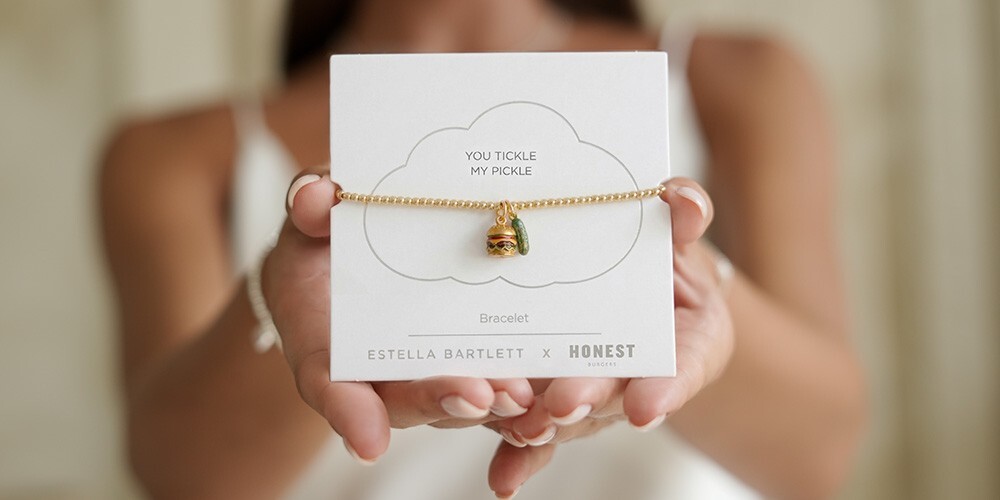
Honest Burger pushed the limits a little further—they have a loyal customer base that loves the brand. They promoted a Burger Necklace (“You tickle my pickle!”) in collaboration with their friends at Estella Bartlett.
Virgin Voyages tapped into readers’ embodied cognition—the sensory associations we link to experiences. Their brand-new fragrance is “inspired by the unforgettable (and occasionally questionable) memories made on our adults-only voyages,” with top notes of sea salt spray and SPF, heart notes of champagne hangovers, and base notes of sunrise yoga and midnight gummy bears. Sounds irresistible.

Philips launched a new precision grooming tool for people’s pets. One Blade Wild features Fur-Density Intelligence and Built-in Treat Dispensers. User reviews were rapturous: “My rabbit has never looked sharper!”

What not to do
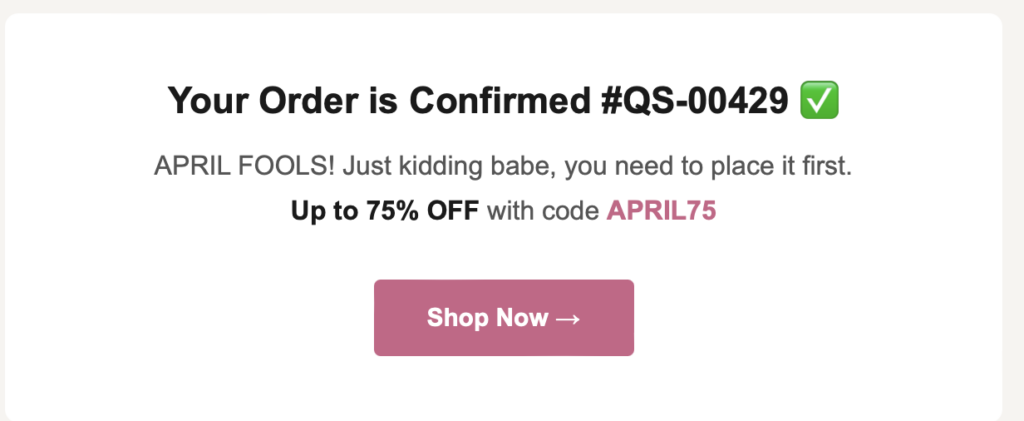
Quasi offered a cautionary example. Their subject line read “Your Quasi Order Is Confirmed,” which would have genuinely alarmed most recipients. Only after opening did subscribers discover: “APRIL FOOLS! Just kidding, babe, you need to place it first.”
Laws specifically prohibiting misleading subject lines are becoming more common, so this kind of prank could have expensive repercussions. This is worth keeping in mind.
Lessons for the broader marketing calendar
April Fool’s Day also offers some useful reminders for the bigger events on your marketing calendar—especially now that we’re living in the age of AI summarizers.
Humor relies heavily on tone and context, which can be hard to convey in email. AI summarizers may take these messages literally rather than jokes—and if the April Fools reveal is buried near the bottom of the email, AI might not include it in the summary at all.
Relevance-sorted inboxes are also a factor. Time-sensitive emails may simply not be seen. We’ve already seen this on Valentine’s Day and Mother’s Day in the UK, where date-specific emails were buried below older ones deemed more relevant by Gmail. Marketers are starting to adapt by explicitly referencing the date, so Gmail recognizes the email as specifically relevant to that day.
Looking for more fooling?
Catch the latest episode of Validity’s Email After Hours podcast, where Danielle Gallant and I had plenty of laughs discussing some of the most outrages strategies. You can find us on Apple, Spotify, YouTube, and Sender Score.