
Key Takeaways
- Verification helps you deliver ROI by ensuring your emails reach valid addresses.
- Avoiding the downstream fallacy means you optimize your spending with accurate analytics and protect your reputation and deliverability.
- Use quality tools that deliver the speed and accuracy to verify your leads without slowing down lead generation or sending workflows.
You can design a beautiful email with carefully targeted messaging, but without email verification, you could be making an expensive mistake. Many email marketers treat verification as maintenance, but you should make it the prerequisite for all other marketing activities. Verifying your leads first minimizes invalid data, enabling you to properly evaluate campaign success and focus your resources where they count.
Table of contents:
- Why email verification is important
- The downstream fallacy in email marketing
- The hierarchy of email success
- How email verification works
- The real cost of bad data
- How to implement a verification strategy
- Why Validity BriteVerify is the industry standard for first step accuracy
- Maximize every send with BriteVerify
Why email verification is important
Email verification is crucial because no amount of A/B testing or artificial intelligence (AI)-generated copy can fix a nonexistent email address.
Invalid or nonexistent email addresses put an invisible ceiling on your campaign’s return on investment (ROI). When you send emails to invalid addresses, you increase your bounce rate. Hard bounces signal to mailbox providers that your data management practices need improvement.
If your bounce rate gets too high, it can affect your sender reputation, which may cause your future emails to land in the spam folder of genuine leads. Some mailbox providers may even block your emails. Proactive verification manages this risk, giving you the freedom to scale your campaigns without fear of suspension.
There are many benefits of email verification. By cleaning up your email database, you ensure you have the sound foundation of a valid dataset to leverage your creative assets fully. Protecting your deliverability ensures you don’t waste these efforts and that as many relevant leads as possible see your emails.
The downstream fallacy in email marketing
Marketing teams create the downstream fallacy when they pour resources into the end of the workflow and neglect data quality from the start. There’s pressure for marketers to show visible results with email output, but analyzing the success of these changes is difficult if you haven’t verified your email list.
Email marketing is trending toward embracing AI and hyper-personalization. Even the most innovative new technologies will not truly succeed if you’re sending emails to invalid addresses.
Another issue is the misalignment that happens between marketing and sales teams. Verification ensures the leads marketing passes on to sales are valid, so the two teams can work together more effectively and reduce internal friction.
A 2025 Gartner report shows that marketing budgets have flatlined at 7.7 percent of overall company revenue. With tighter budgets, you need to maximize your resources and avoid sending emails to ghosts or invalid domains. Correcting the downstream fallacy requires you to place more emphasis upstream and treat audience validity as the key launchpad for subsequent marketing activities.
The hierarchy of email success
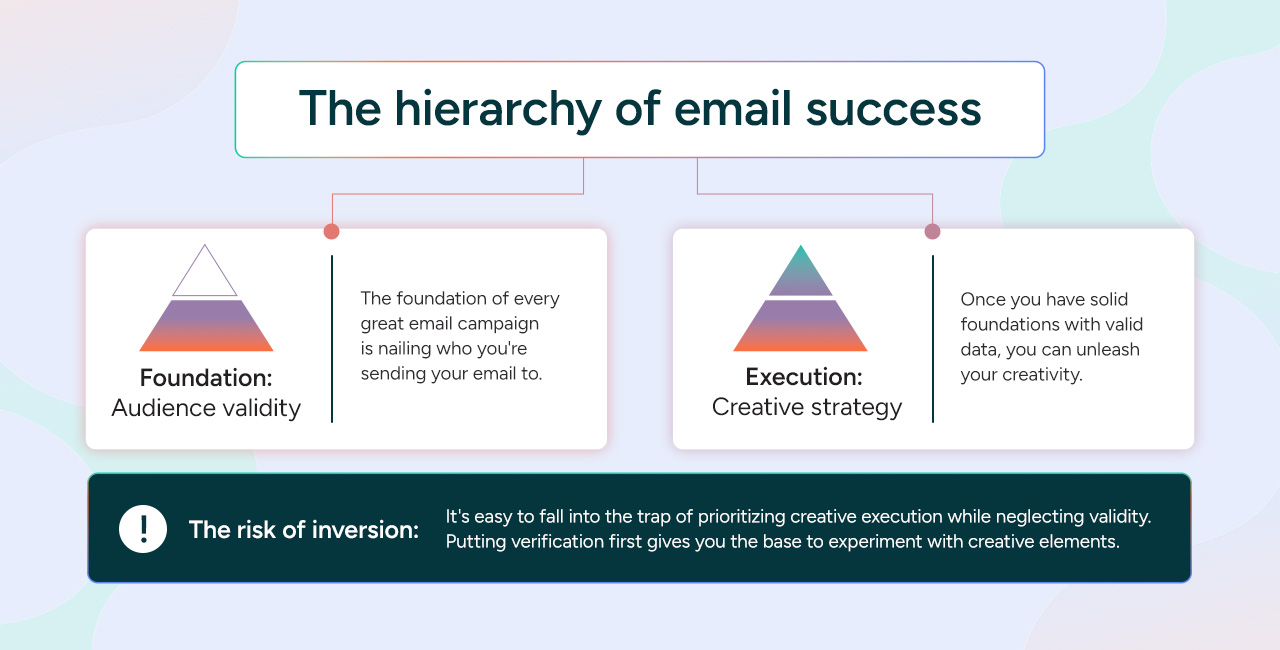
A successful email campaign still requires strong creative elements, but you have to do things in the right order.
1. Foundation: Audience validity
The foundation of every great email campaign is nailing who you’re sending your email to. This informs the creative assets and stops you from shouting into the void, both from a messaging standpoint and in terms of reaching valid email accounts. By setting good foundations, you put your resources to the best use.
Putting this step first helps you in the short term and as you scale up, ensuring your list is healthy enough to grow without resulting in higher bounce rates.
2. Execution: Creative strategy
Once you have solid foundations with valid data, you can unleash your creativity. Copy, design, and personalization tactics all come into play here. While this layer is responsible for engagement, it relies on the deliverability that you get from email verification.
3. The risk of inversion
It’s easy to fall into the trap of prioritizing creative execution while neglecting your list. Putting verification first gives you the base to experiment with creative elements and optimize them, rather than making educated guesses.
The danger of inverting this hierarchy is that you may create a false sense of security. To correct this inversion, you need a cultural shift within your team. You should champion clean data metrics as much as click-through rates, for example.
How email verification works
Email verification is more than just checking for an “@” symbol. Let’s break down the technical process.
Beyond syntax
Basic syntax checks can help weed out data that clearly aren’t email addresses. A syntax check determines whether an address looks like an email address, but it can’t verify whether that address is still active, whether the inbox is full, or whether the server rejects external mail.
Syntax checks are important, but going further to identify other types of bad data is crucial. You need to be able to distinguish between temporary issues, such as a full mailbox, and permanent failures, such as nonexistent users. You can then prune your list and protect your Sender Score from hard bounces.
Types of bad data
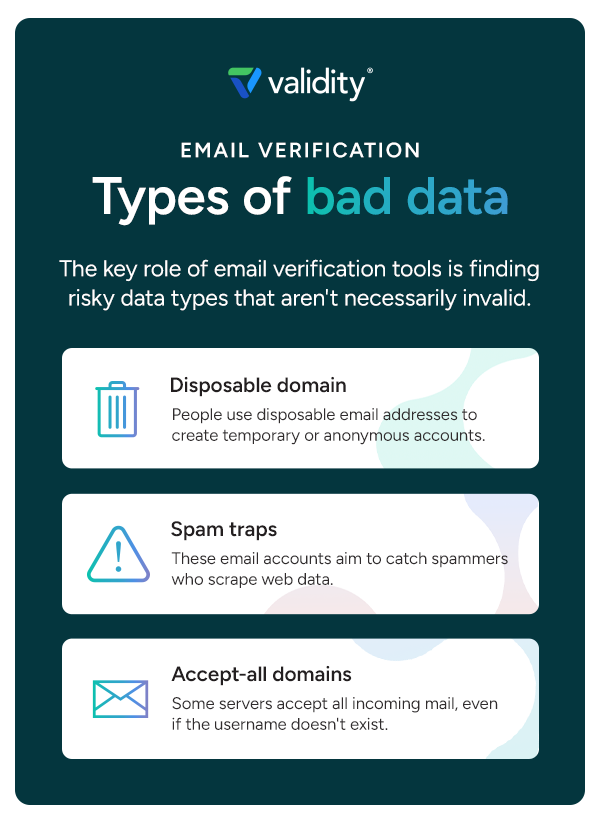
A key role of email verification tools is finding risky data types that aren’t necessarily invalid, but could still harm your program.
- Disposable domains: People use disposable email addresses to create temporary or anonymous accounts. Removing these can help ensure your engagement data reflects genuine interest. Removing disposable email addresses can also help improve deliverability and sender reputation.
- Spam traps: These email accounts aim to catch spammers who scrape web data. Identifying and removing spam traps is a powerful way to protect and build your sender reputation
- Accept-all domains: Some servers accept all incoming mail, even if the username doesn’t exist. This makes it hard to determine whether a user exists and is engaging with your email.
Using email validation tools can provide the first line of defense for compliance. By identifying and removing spam traps or high-risk domains associated with purchased lists or poor data hygiene, you minimize your risk of violating the General Data Protection Regulation (GDPR), California Consumer Privacy Act (CCPA), or Canada’s Anti-Spam Legislation (CASL).
The real cost of bad data
Eliminating bad data isn’t just about boosting technical performance—it’s also about protecting your bottom line.
Direct costs
In terms of direct costs, email service providers charge by volume or subscriber count. By purging these invalid or nonexistent contacts, you eliminate this waste and immediately improve the overall integrity of your data, ensuring your budget focuses on verifiable, reachable leads. Streamlining your email list could help you bump down a tier, reducing your overall email marketing costs.
Indirect costs
There are indirect costs, too, where bad data skews analytics. Properly verifying your email list ensures you can run A/B tests accurately. When you have a verified email list, you can report more confidently on marketing’s impact on your business. This makes it easier for your marketing teams to optimize future strategies.
Every time you send an email to an invalid address and get a hard bounce, your domain reputation takes a hit. Over time, this can lead to indirect costs as mailbox providers begin to deprioritize your domain and mark you as spam. This can affect the deliverability of your future campaigns. In contrast, with a high-quality list, you are less likely to send emails that bounce, protecting your sender reputation.
Staying proactive with verification means you spend your time on growth, not costly repairs to your domain reputation.
Invalid data can also create operational drag, slowing down your other business functions. When marketing passes invalid leads to sales, your team wastes valuable time and loses trust in marketing-generated leads. With regular verification, you equip your team to focus on real leads and create greater impact.
Over time, bloated databases can slow down sync times between your platforms. Bad data can unnecessarily increase this load and raise storage costs for backups. Regularly verifying your email lists helps reduce the amount of bad data that builds up.
Opportunity costs
You also have the opportunity cost of leads that you could have saved. These are email addresses you could have corrected at the point of capture, such as a human-error typo in a domain name.
Real-time correction creates a frictionless user experience, reinforcing your brand’s professionalism and ensuring that the prospect gets the information they requested instantly.
How to implement a verification strategy
There are different types of email verification you can use to clean up your existing lists and help minimize bad data from future collections.
Real-time verification
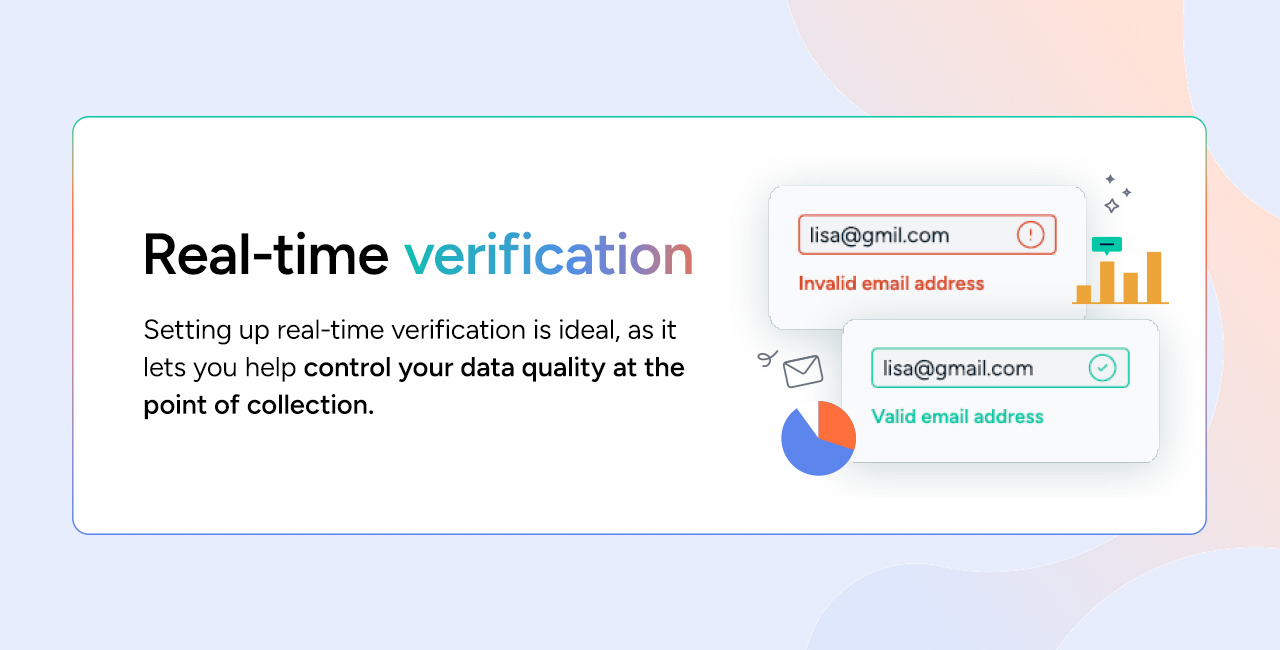
Setting up real-time verification lets you help control your data quality at the point of collection. Real-time tools have application programming interfaces (APIs) that prompt the user to address any typos or correct their details at the point of collection before you add them to your customer relationship management (CRM). This means you minimize the bad data you pass on to the sales team, helping address hand-off anxieties.
Bulk verification
Sometimes it is necessary to clean the backlog or perform extra email list cleaning. Bulk verification tools can help you improve the data integrity of your existing lists. Even if your list was immaculate six months ago, data naturally decays over time. This can be a particular challenge in the fast-moving business-to-business (B2B) space, where people change jobs, companies go out of business, or domains expire.
Regular maintenance
When you make data hygiene a regular part of your maintenance schedule, you can catch invalid addresses before your next send. This helps reduce the number of hard bounces you might get, increasing deliverability. You also ensure your active audience matches your actual audience. Setting the right cadence for verifying and purging emails depends on your organization’s unique needs. If you’re in a particularly high-velocity industry like software-as-a-service (SaaS) or ecommerce, where leads churn more quickly, a more regular cadence may be necessary.
Verify before sending
It is a good practice to verify your email list before sending any major seasonal campaign, such as Black Friday or a product launch. When you’re counting on your email marketing to deliver in these moments, having the most up-to-date list helps boost deliverability and drive campaign success.
Manage the unknowns
Email verification tools also return a small percentage of results with unknown email address status. Server timeouts or recipients’ strict security settings can cause this. A common mistake is treating the unknowns as valid and including them in your next big campaign. This is risky as you could increase your bounce rate.
A better strategy when your verification tools find unknowns is to segment these contacts onto a quarantine list. You then test them with low-volume, text-only reengagement emails to see if they bounce or reengage. By using a secondary sending internet protocol (IP), you can protect your primary sender’s reputation while recovering genuine leads.
Why Validity BriteVerify is the industry standard for first step accuracy
When choosing a partner for email verification, speed and accuracy are crucial. Tens of thousands of organizations rely on Validity’s solutions, including our BriteVerify email verification solution, because they deliver to improve customer data quality.
BriteVerify can handle massive volumes of data without latency. This means the real-time verification API never slows down the user experience on your forms. Whether you’re processing thousands of leads an hour or millions of records in a bulk batch, the tool scales to meet your demands.
Accurate email verification depends on the quality of the email provider’s network. BriteVerify has close relationships with inbox providers and a vast global data network. This allows for more accurate status checks than competitors who just scrape data. By reducing the number of unknown results in your email lists, you can retain more valid leads while removing bad data that may affect your sender reputation.
BriteVerify integrates seamlessly into your existing systems, saving you the headache of onboarding.
Maximize every send with BriteVerify
Prioritizing email verification enables your creative team to leverage its resources properly. Once you have trusted data, you can focus on innovation and optimization. BriteVerify allows you to verify your list at the point of capture, through regular bulk validations, or even right before you send your campaign, protecting your sender reputation and helping you to engage more interested leads.
Get started by requesting a demo today.