
Key takeaways:
- Keeping your CRM data in good shape takes ongoing care—it’s not a one-and-done fix.
- With the right monitoring framework in place, you can stay on top of your data and keep results on track.
- The right data quality tools will grow with your business and keep the time you spent building customer relationships from going to waste.
Every smart marketing campaign or sales play depends on accurate, up-to-date CRM data. After all, your teams can only act on what they know. But as teams collect, process, and store more customer info—like names, job titles, and account details—mistakes, duplicates, and outdated records can sneak into your database.
That’s where data quality monitoring comes in. It’s not just about keeping your CRM tidy—it’s about giving your team the confidence to make smarter decisions. If contact info is wrong, leads are duplicated, or account details are outdated, you risk sending the wrong message to the wrong person, wasting time and budget. Having a process in place to monitor your CRM data quality ensures you target the right customers, personalize messages that actually resonate, and make decisions—like prioritizing leads or planning campaigns—based on a true picture of your pipeline.
Table of Contents:
- What is data quality monitoring?
- Why reactive cleaning fails
- A proven data quality monitoring framework
- Essential data quality monitoring techniques
- Choosing the right data quality monitoring tools
- Why trust Validity for data quality monitoring?
- Turning data insights into action
What is data quality monitoring?
In revenue operations and email marketing, data quality monitoring isn’t just a one-time cleanup—it’s a continuous process. It’s all about keeping an eye on your CRM data and alerting teams to data problems before they snowball. Think of it like a smoke alarm: always on, always warning you before a small issue becomes a full-blown campaign disaster. Without the right framework in place, a duplicate lead could trigger two reps to email the same person, or an outdated email address could make your best campaign bounce, the list goes on and on.
Data monitoring isn’t the same as data cleaning. Cleaning is reactive—it’s manual, periodic, and usually done after mistakes have already caused trouble. Data quality monitoring, on the other hand, is proactive and often automated. It catches errors in real time, letting teams step in early. Whether it’s missing phone numbers, outdated account info, or incorrect segmentation tags, a strong data quality monitoring framework ensures you spot these issues before they hurt inbox placement, muddy customer views, or waste your team’s time.
Using the right data quality monitoring tools and data quality monitoring techniques, teams can act on their CRM data, run campaigns that actually hit the right audience, and make better decisions that drive growth.
Why reactive cleaning fails
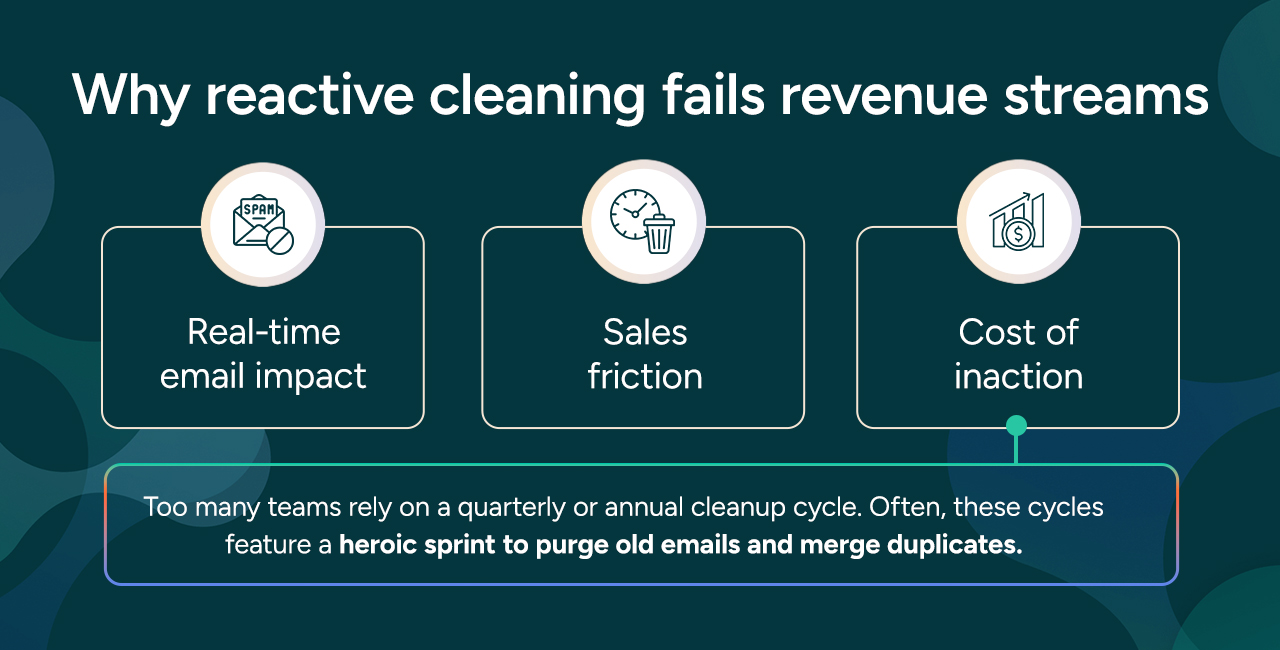
Too many teams rely on a quarterly or annual cleanup cycle for their data. Often, these cycles feature a heroic sprint to purge old emails and merge duplicates. However, as soon as the process ends, new errors sneak right back in. Here’s why reactive models can’t keep up:
- Real-time email impact: Unmonitored invalid emails affect more than quarterly rates—they can tank your send reputation instantly and make it harder to deliver future campaigns.
- Sales friction: Duplicate records break the “single customer view” and cause sales reps to waste time and risk negative customer interactions, which can shatter trust and momentum.
- Cost of inaction: The cost of handling data problems can escalate quickly. Consider the 1-10-100 rule: It costs $1 to prevent a problem up front, $10 to fix an issue at the start, and $100 to address an undetected problem that resulted in a large error. Ultimately, the sooner you catch and address data issues, the less expensive and disruptive the fix.
A proven data quality monitoring framework
Achieving lasting data quality requires more than occasional fixes. It depends on a structured, ongoing approach. Businesses can’t afford to let problems slip through the cracks or wait for quarterly reviews to uncover costly issues. With a thoughtful framework in place, organizations can stay ahead of data decay, confidently supporting sales, marketing, and revenue operations. By building systematic checks and balances into your processes, you create a robust defense that keeps your data and results reliable.
To stop decay before it costs you, adopt this three-step continuous monitoring loop:
- Establish baselines: Define your healthy data standards. For a marketer, that might mean 95% of contacts have valid emails or something similar. Set your own targets for data enrichment, completeness, and accuracy.
- Implement real-time validation: Check new data at entry points, such as web forms, imports, and integrations. Catch missing fields and invalid emails and phone numbers before they hit your CRM.
- Schedule automated processes: Even with validation rules and real-time checks, errors can slip in through third-party integrations, manual imports, system migrations and changes over time. Automate scans using advanced matching logic to catch duplicates, outdated contacts, and discrepancies that basic entry validation can miss.
Essential data quality monitoring techniques
Keeping your CRM data high-quality means using data quality monitoring techniques to make sure it stays accurate, relevant, and actionable as your business grows. With new records coming in all the time and customer details constantly changing, strong data quality monitoring techniques are key to protecting your marketing and sales efforts from hidden problems. The right data quality monitoring tools and strategies make it easier to catch issues early and keep your data working for you, not against you. Here are the main tools and tactics that make monitoring effective:
- Profiling: Regularly analyze your database for missing or inconsistent information. Look for blank fields, odd state or country codes, or inconsistent formatting.
- Deduplication: Advanced matching algorithms spot and merge fuzzy matches For example, these algorithms can merge duplicates like “Jon Smith” and “Jonathan Smith” to prevent fragmenting the customer experience with duplicate accounts and outreach.
- Recency verification: Validate how fresh your records are. This is especially critical for email. Routinely validate your list to ensure you’re not messaging inactive, abandoned, or mistyped addresses.
Choosing the right data quality monitoring tools
Spreadsheets and standard CRM reports just don’t cut it anymore—they can’t keep up when your dataset grows. Here’s what you should look for instead:
- Automation capability: Choose tools with automated scheduling. Data checks should run without requiring manual action.
- CRM integration: Monitoring should happen inside your workflow, not in siloed exports or imports. Integration with CRM platforms is a must.
- Flexibility: Manual solutions often break at high volumes. Reliable monitoring engines support thousands or millions of records.
Why trust Validity for data quality monitoring?
Validity has over 25 years of experience in data quality. As a global leader, tens of thousands of organizations, ranging from startups to Fortune 500 companies, trust us to deliver reliable solutions. Each day, these businesses rely on Validity to manage and protect millions of CRM records.
Our data management tools help teams to get the most out of CRM data. With centralized solutions to help teams work faster and automated processes to boost team productivity, you can easily manage your data needs while saving time and resources.
And because we’re certified with ISO 27001 and SOC 2, even teams in highly regulated industries or privacy-conscious environments can feel confident. With us, it’s not just about cleaning data—it’s about keeping the revenue and reputation your data drives safe.
Turn data insights into action
TLDR? Switching from one-off cleanups to continuous monitoring is a smart move. You know your data is actually working for you, not against you. When you can trust your CRM data, everything that depends on it—sales forecasts, campaign results, and customer decisions—becomes more reliable.
DemandTools from Validity is your top-rated data quality and management solution.Stop guessing and be confident in your data health. Take the first step by scheduling a personalized demo of Validity DemandTools. Start monitoring your data quality today.