
Copeland easily switches ESPs using Validity tools.
The challenge: Copeland was spending too much time juggling marketing campaigns between two tools.
In 2023, Copeland transitioned from being part of Emerson to an independent company. 75 percent of their email marketing campaigns, both internal and external, were managed through Oracle Eloqua and the remaining 25 percent were on Salesforce Marketing Cloud (SFMC).
As you can imagine, bouncing between the two tools added hours to their workflow and unnecessary confusion. After 18 months of juggling the tools, they decided to make their workflow simpler by bringing everything into SFMC.
Making that decision was one thing, but executing it was another.
“With Litmus Builder, we create accessible, on-brand emails faster—while continuously building our team’s skills and confidence.”
Lisa Wester, Senior Manager for Global Marketing Automation at Copeland
The solution: Validity products helped ease Copeland’s transition, making it much smoother.
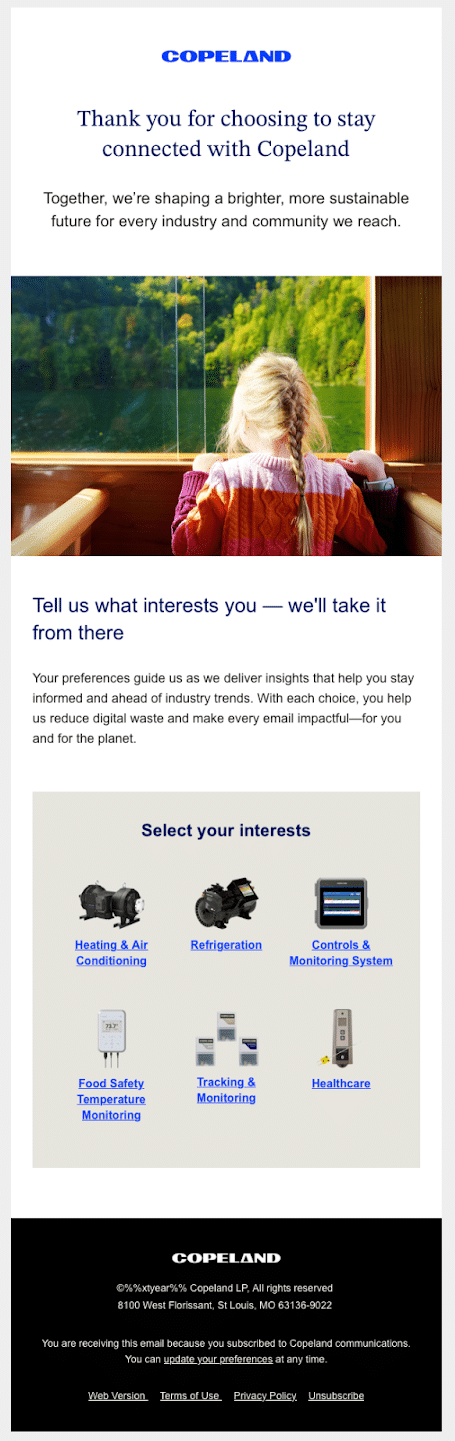
Copeland’s top priority was to migrate only engaged and active contacts into SFMC. The process began with a cohort of 80,000 subscribers who joined or engaged within the last 24 months.
BriteVerify
To ensure list integrity, Copeland used BriteVerify to validate this group, identifying legitimate email addresses. The results were telling—after verification, 50% of the initial records were deemed invalid and excluded from migration.
DemandTools
The team took their active contact list from Eloqua and ran it through DemandTools to find and update existing contacts already in SFMC. This ensured no duplicate contact records were added and their database remained clean.
Litmus
When Lisa took over the Global Marketing Automation team in late 2023, they tailored the Litmus Email Design System (EDS) to match brand guidelines and streamline workflows between Eloqua and SFMC.
This customization meant the team didn’t have to learn a new tool for building emails during or after the migration, saving at least a week to learn a new tool with minimal interruptions. They also leveraged Litmus Proof to handle changes, iterations, and stakeholder approvals, ensuring everything stayed aligned.
“Validity has transformed how we work. BriteVerify keeps our data clean by blocking invalid emails in real time, DemandTools simplifies CRM updates, and Litmus has been my go-to tool for over a decade. Now, it’s empowering my team to build, test, and perfect every email before we hit send.”
Lisa Wester, Senior Manager for Global Marketing Automation at Copeland
The results: Copeland overcame content migration challenges.
The migration was pretty flawless, until Copeland discovered a mismatch in unique identifiers between platforms: Eloqua used email addresses, while SFMC relied on Salesforce IDs.
An audit revealed that about 50 percent of subscriber records lacked essential data, preventing migration to a Salesforce ID.
To address this issue, the team implemented a strategic approach:
- Data collection: a custom web form was created to gather missing subscriber information.
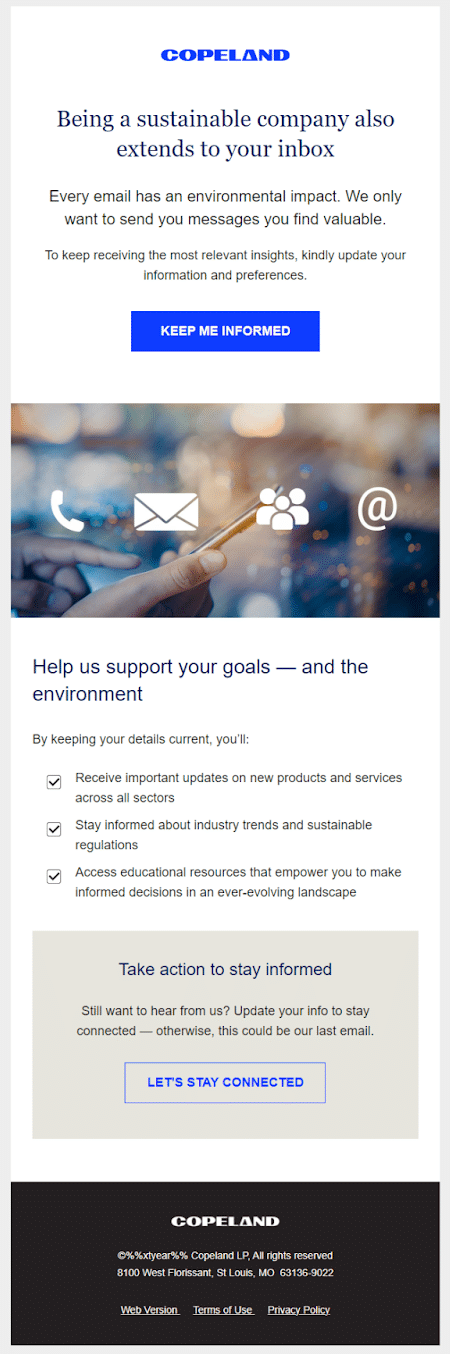
- Re-engagement campaign: a targeted email journey, designed with Litmus, encouraged users to complete the form.
- Lead generation automation: the form automatically generated lead records and Salesforce IDs, capturing crucial data like opt-in status and content preferences.
They launched a form to collect the missing data and created a targeted reengagement journey using Litmus to bring the contacts back into the fold.
Copeland focused on migrating the most engaged Eloqua subscribers first. This segment-focused approach started with batches of 5,000, ensuring they protected their sender reputation and deliverability.
The team improved campaign performance through dynamic segmentation based on engagement, location, and language, resulting in a 2 percent conversion rate from users choosing to maintain their email relationship.
Copeland is a global leader in sustainable heating, cooling and refrigeration solutions for commercial, cold chain, industrial, and residential industries. They help reduce carbon emissions, improve energy efficiency, and safeguard perishable food and medicine through the use of their climate-friendly refrigerants.
Their technology is proven in over 200 million installations worldwide with 3,400+ active and pending patents.