Key takeaways:
- Real-time verification filters out inaccurate contacts or mistakes at the moment of entry, protecting data quality and improving conversion rates from the start.
- Bulk verification helps companies clean, analyze, and restore accuracy to existing contact lists—especially valuable before major campaigns or when dealing with older data.
- Enterprise businesses benefit from running both in tandem: real-time verification prevents bad data from entering your system, while bulk verification keeps existing data healthy over time.
Your customer database isn’t just important—it’s everything. Every marketing campaign, sales opportunity, and customer interaction depends on the quality of your contact data. The smallest error at the front door can have ripple effects across your entire operation.
Just how much is riding on your data quality? According to our research, 37 percent of CRM users said they lose revenue as a direct consequence of poor data quality—through lost leads, failed campaigns, wasted spend, and sender reputation damage. The scale of that loss makes it critical for any business to take proactive, ongoing action.
There are two primary tools for maintaining contact data quality: real-time verification, which stops bad data before it enters your system, and bulk verification, which cleans and restores accuracy to the data you already have. Understanding what each does—and when to lean on each one—is the foundation of a strong data quality strategy.
Table of contents:
- What is real-time verification?
- What is bulk verification?
- Using both types of verification together
- Real-world scenarios: The power of data quality in action
- Best practices for implementation
- Clean up your data, protect your revenue
What is real-time verification?
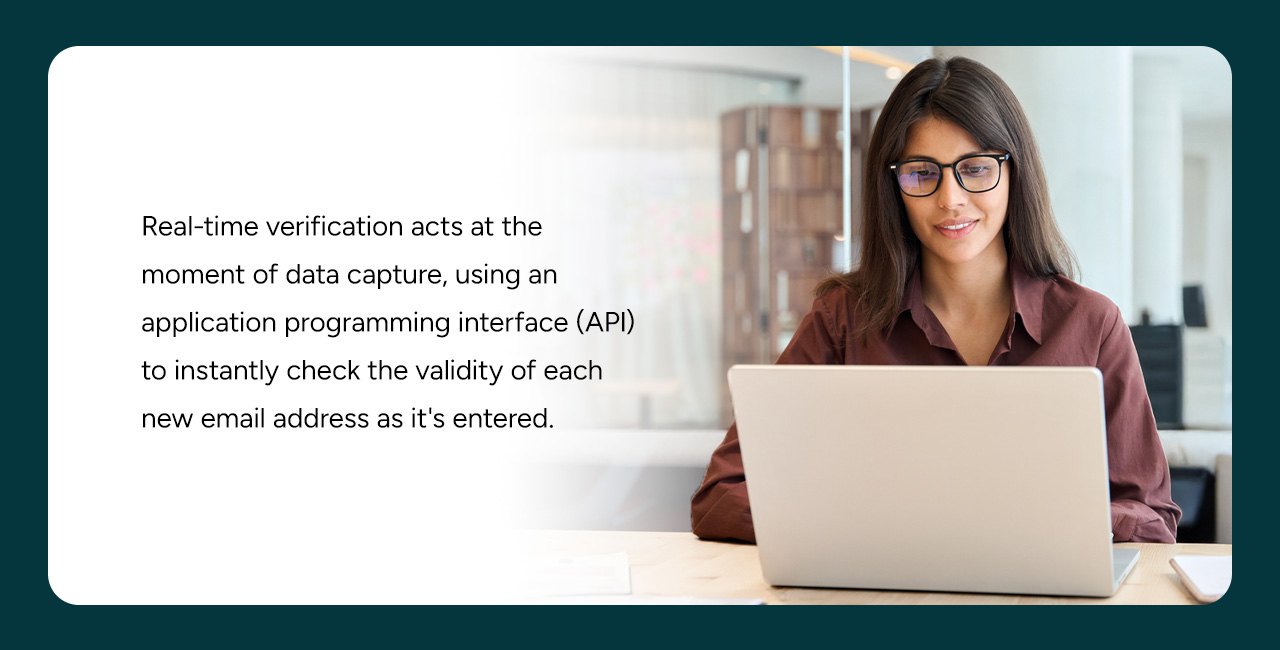
Real-time verification is the gatekeeper of your data ecosystem. Using an API, it instantly checks the validity of each new email address at the moment of capture—before anything hits your CRM.
As soon as a user enters their email, validation runs in the background. It checks for proper syntax, confirms the domain is valid, and uses provider-appropriate methods to verify the mailbox exists. If there’s a typo, the system can surface a helpful “Did you mean?” prompt. If someone enters a fake, temporary, or burner address, it’s flagged immediately.
When it’s most valuable
Real-time verification is essential any time you’re capturing new contacts. It’s especially impactful at high-intent moments when users are most engaged:
- New account creation
- Newsletter signups
- Gated content downloads
- Ecommerce checkout
At these moments, a single typo can mean a lost lead or a frustrated prospect. Real-time verification catches those errors instantly and gives users the chance to correct them—saving contacts that would otherwise fall through the cracks. It also keeps bad actors from intentionally contaminating your CRM with fake or disposable addresses.
Who should prioritize it
Real-time verification is a must for high-traffic websites, ecommerce stores, and any business that relies on rapid lead generation or repeat customer engagement. If every valid contact matters to your pipeline, this is one of the most effective investments you can make.
What is bulk verification?
Where real-time verification is your gatekeeper, bulk verification is your housekeeper. Rather than catching errors as they happen, it tackles the accumulated errors already living in your data.
Bulk verification systematically scans your entire contact list—handling thousands or even millions of records in a single pass. The result is a comprehensive report showing which emails are valid, which are risky, and which should be removed.
When it’s most valuable
Data decays whether you’re paying attention or not. According to the Customer Data Platform Institute, email marketing databases degrade naturally by roughly 23 percent annually. People change jobs, abandon inboxes, or simply stop engaging. Bulk verification is what keeps that decay from quietly undermining your campaigns.
It’s particularly important for:
- Lists you haven’t emailed in three or more months
- Pre-campaign cleanses before major holidays or promotions
- Database migrations, where stale data can damage deliverability and CRM accuracy
- Re-engagement efforts targeting old or dormant leads
- Any time you’re working with purchased or third-party lists (we recommend steering clear of these. Use zero or first-party data for better results)
Who should prioritize it
If you manage marketing operations, oversee large campaigns, or are the person who handles the fallout when bounce rates spike, bulk verification is your go-to tool. It’s also essential for any team inheriting data from a migration, acquisition, or legacy system.
Using both types of verification together
For most enterprise businesses, the right answer isn’t one or the other—it’s both. Real-time verification ensures clean data enters your system from day one. Bulk verification ensures your existing data stays clean over time. Together, they close the loop on data quality across your entire contact lifecycle.
Here’s how that plays out across common business scenarios:
E–commerce: Real-time verification is critical for order confirmations, receipts, and customer communications. Bulk verification keeps older customer lists clean for promotional campaigns and re-engagement.
B2B SaaS: Real-time verification on demo request forms and product registrations ensures high-value leads are captured accurately. Bulk verification cleans up older prospect lists so nurture tracks aren’t sending to dormant or invalid addresses.
CRM migrations: Bulk verification should be a standard step in any major data migration. Real-time verification should be embedded across all active lead capture touchpoints to prevent new data quality issues from accumulating.
Real-world scenarios: The power of data quality in action
Here are a few real-world examples of the benefits of data quality:
- E
–commerce and fundraising: Reading for Education (RFE) needed a sustainable solution for ongoing data quality. Before investing in verification, their inbox placement rate hovered around 30 percent. By pairing real-time verification with periodic bulk cleaning, they achieved a 200 percent lift in email-attributed revenue and an inbox placement rate of over 95 percent. - Legal and professional services: Freshfields Bruckhaus Deringer LLP used bulk email verification during a major CRM migration to Salesforce, ensuring their valuable contact data remained trustworthy and their global client service workflows stayed intact.
- Digital media and marketing: Digital media company1440 stabilized deliverability by increasing email visibility and limiting their list to active, engaged contacts—achieving nearly 100 percent inbox placement rates.

Best practices for implementation
Verification tools are only as effective as the operational strategy behind them. Here’s how to set your team up for long-term success:
- Define data quality ownership. Assign clear roles across Marketing, IT, and Sales Operations. Determine who monitors bounce rates, who authorizes bulk cleanings, and how often they occur.
- Embed verification at every capture point. Real-time API verification should be active on all web forms, landing pages, and anywhere email addresses are collected.
- Schedule routine bulk sweeps. At minimum, run a bulk verification at least quarterly—more frequently if your database is large or your campaigns are high-stakes.
- Monitor performance metrics. Track bounce rates, open and click rates, and sender reputation metrics. Set alerts for sudden changes that could signal new or existing data quality issues.
- Centralize management. Using a single platform for both real-time and bulk verification reduces operational silos and makes it easier to maintain a complete picture of list health.
- Document and train. Keep clear policies on when and how verification runs. Train staff to recognize common data entry errors and understand why data quality matters to the business.
- Prioritize compliance. Work with verification partners that meet strong privacy and security standards, and ensure all data practices align with GDPR, CCPA, and any other applicable regulations.
Clean up your data, protect your revenue
Whether you’re focused on stopping bad data at the door, restoring accuracy to aging lists, or building an integrated long-term approach, the investment in data quality pays dividends well beyond any single campaign. Higher conversion rates, better deliverability, and lasting customer trust all start with knowing your contact data is accurate.
Evaluate your current workflows and identify where data quality gaps might be costing you more than you realize. Validity offers the tools and expertise to help—schedule a demo to see our solution in action.