
If you aren’t actively maintaining your database, a significant portion of your marketing budget is likely being spent trying to reach people who aren’t there. An accurate home address from 2020 is useless if your customer moved in 2023. Data quality timeliness is the often-overlooked hero of successful marketing operations.
In this guide, you will understand the real-world impact of data timeliness on your marketing campaigns, learn to identify and measure the freshness of your data, and discover how to automate data quality and ensure your data is always up to date.
What is data timeliness?
For data to be of high quality, it must accurately reflect the real world at the time of use.
For example, you are running a re-engagement campaign for customers who haven’t purchased in six months. Your Customer relationship management (CRM) shows that John Smith lives in Chicago. You segment him into the Midwest Promotion group and send an email featuring an Chicago-based event. However, John moved to Phoenix three months ago. The data was accurate when it was entered, but it lacked timeliness. The result? A confusing customer experience and a wasted marketing impression.
If you are mailing a quarterly catalog, updating addresses once every three months is timely. If you are sending a transactional receipt, the email address must be valid instantly. Timeliness is about aligning data cleanups with the rhythm of your business operations.
The high cost of stale data
When timeliness in data quality falters, the consequences ripple through your organization. Stale data actively works against your goals. Gartner estimates that poor data quality costs organizations at least $12.9 million annually. A significant portion of this cost is attributed to data decay.
Here is how it impacts your bottom line:
- Damaged sender reputation: Email service providers (ESPs) track how many of your emails bounce. If you keep hitting invalid addresses because your list hasn’t been scrubbed in a year, ESPs will flag you as a spammer. Eventually, even your valid emails will end up in the junk folder.
- Wasted ad spend: Inaccurate customer segmentation leads to targeting the wrong audience. You might be sending ads to new homeowners when your list includes people who sold their house six months ago. Every impression on a stale contact is budget burned with zero chance of return on investment.
- Poor personalization: Personalization relies on context. If the data of a customer’s job title, location, or company size is outdated, your personalized messaging will feel disconnected and generic.
- Flawed decision-making: If your reports are based on last year’s realities, your strategy for next year is already flawed.
How to measure data timeliness
You can’t fix what you don’t measure. Assessing the freshness of your database doesn’t require complex algorithms, but it does require a consistent approach. Here are three methods to gauge the health of your data.
1. Data age analysis
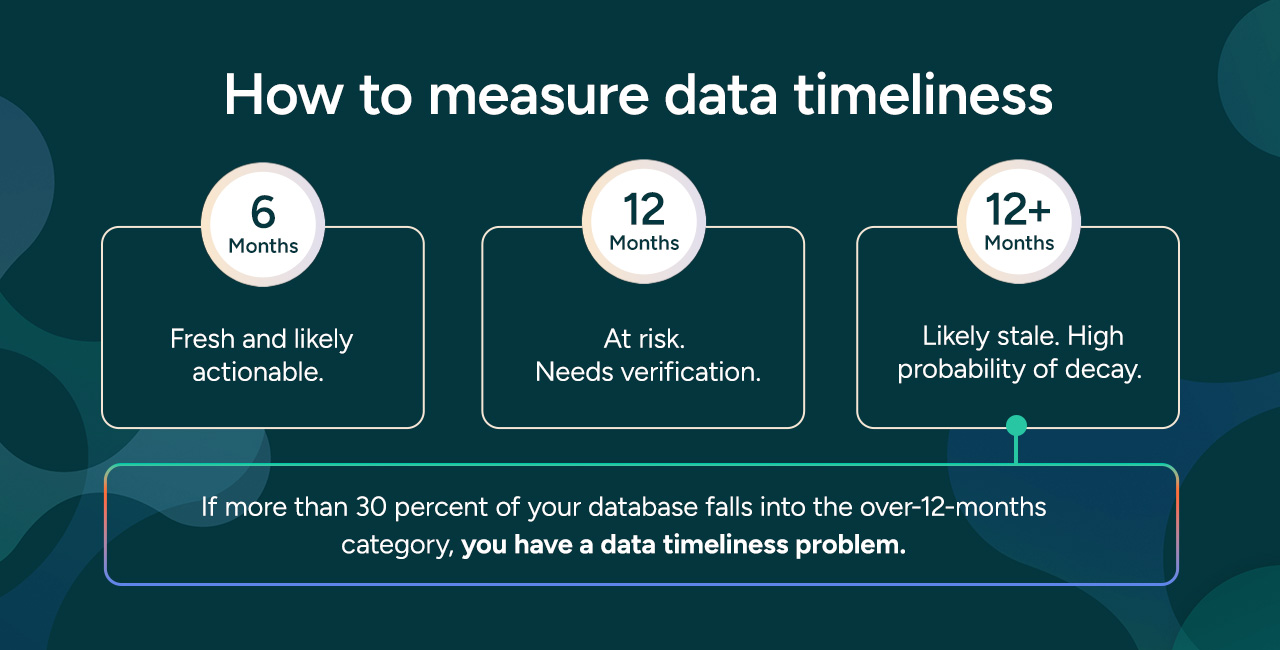
The simplest metric for timeliness is the “Last Modified Date.” Run a report on your key contacts and group them by the date of their last update:
- Zero to six months: Fresh and likely actionable.
- Six to 12 months: At risk. Needs verification.
- Over 12 months: Likely stale. High probability of decay.
If more than 30 percent of your database falls into the over-12-months category, you have a data timeliness problem. This analysis gives you a baseline decay rate to track over time.
2. Refresh rate vs. business need
Compare the frequency of your data updates against the volatility of the data itself. For example, firmographic data, like company names, rarely change. In contrast, contact data is highly volatile, as people frequently change jobs and email addresses. A refresh rate of every 90 days is often necessary to maintain timeliness in data quality.
If your business needs demand monthly accuracy for billing, but your refresh rate is quarterly, you have a timeliness gap that needs to be closed.
3. User feedback and error rates
Sometimes the best measurement is qualitative. Listen to the people who use the data daily. Are they complaining that “half these numbers are disconnected”? Are they flagging contacts as “no longer at company”?
Combine this feedback with system error rates, like hard bounce reports from your email marketing platform. A spike in hard bounces is a lagging indicator that your data timeliness has already degraded significantly.
Strategies for improving data timeliness
Improving timeliness and data quality is an operational discipline. To move from reactive firefighting to proactive maintenance, you need a strategy that covers people, processes, and technology.
Establish data governance policies
Who is responsible for keeping data fresh? Without clear ownership, data quality management falls to the bottom of everyone’s to-do list, but it needn’t be this way.
Create a data governance policy that defines:
- Fields that are mandatory
- When a record should be archived or deleted
- Those accountable for the health of specific datasets—for example, marketing owns leads while sales owns accounts
Implement regular data audits
A lot of work goes into campaigns. Give your efforts the best chance of success by scheduling quarterly audits to assess the health of your database. Look for patterns of decay, like a specific lead source that consistently provides outdated information.
An advanced data quality monitoring tool can help you profile your data quality and offer a record quality trend indicator to show if your cleansing efforts are on track or falling behind.
Automate your data cleansing
Manual updates are too slow to keep up with the rate of data decay. By the time a human validates 1,000 records, 50 of them might have already changed again.
Automation is the only scalable way to ensure data timeliness. This involves setting up background processes that standardize, deduplicate, and verify data as it enters your system—and on a recurring schedule thereafter.
Achieve effortless data timeliness with automation
The ultimate goal for any Marketing Ops Manager is to have a database that cleans itself. While that might sound like a dream, modern tools make it a reality. DemandTools from Validity is designed to automate the heavy lifting of data quality by proactively maintaining timeliness.
DemandTools supports campaigns that convert in these ways:
- Automated deduplication: Duplicate records are often a source of conflicting, outdated information. DemandTools identifies and merges duplicates, allowing you to preserve the most recent data points, like a new job title, while discarding outdated ones.
- Scheduled scenarios: You can build specific cleansing scenarios, like standardizing state names or flagging inactive contacts. You schedule them to run automatically at night and wake up to a fresh database every morning.
- Mass modification: When you identify a segment of data that has become stale, DemandTools allows you to update thousands of records in minutes, ensuring your team isn’t working with obsolete information.
By automating these tasks, you remove the human bottleneck from data quality. Your data remains timely not because someone remembered to update it, but because your system is built to reject decay.
Why trust us with your data’s timeliness?
Tens of thousands of customers use DemandTools from Validity to manage their data. Our commitment to helping our customers grow faster with better data has driven us for more than two decades. We help businesses of all sizes tackle data decay and maintain the high-quality, timely data that drives better operations, smart decisions, and stronger customer relationships.
DemandTools allows you to effortlessly clean, organize, and maintain your data’s timeliness. We give you the control to manage data quality and ensure timeliness at scale—from eliminating duplicates to standardizing fields and scheduling automated jobs that keep your data fresh.
You can also safely mass import, export, and modify records. This ensures every data project is as successful as possible, from a simple list upload to a complex CRM migration. With Validity as your strategic partner, your team has complete confidence in the integrity of your data.
Make timely data your competitive advantage
Data is one of your organization’s most valuable assets, but like any asset, it depreciates if neglected. In a competitive landscape where personalization and speed are paramount, data timeliness is often the differentiator between a deal won and an opportunity lost.
Stale data slows you down, wastes your budget, and frustrates your team. Fresh, timely data empowers you to move fast, target with precision, and make decisions with confidence.
Are you ready to stop losing revenue to stale data? Talk to an expert at Validity today or schedule a demo to discover how DemandTools can help you automate data quality and ensure your data is always timely and accurate.