Key Takeaways
- Skipping email list verification doesn’t just hurt deliverability—it leads to wasted spend, flawed analytics, compliance risk, and increased exposure to fraud. These are critical business impacts for marketing leaders.
- Clean, continuously validated email data is the foundation of modern email marketing. Without it, AI, personalization, and segmentation all break down, compromising their potential.
- The most effective teams treat email list verification as an always-on discipline—combining proactive real-time validation, ongoing list hygiene, and internal accountability.
Your email list isn’t something you build once and move on from—it’s constantly changing (and decaying). People switch jobs, inboxes get abandoned, and domains expire. Understanding this decay helps marketing decision-makers maintain an effective and efficient email program.
So bad data doesn’t just sit there in your email service provider (ESP)—it actively works against your marketing efforts. Beyond these immediate symptoms, neglecting email verification can undermine the entire data life cycle, leading to:
- Emails landing in spam
- Engagement rates dropping
- Wasted marketing budget
- Campaign performance getting harder to explain
In 2026, email list quality and email verification aren’t a “nice-to-have.” They’re table stakes if marketers want your emails to land—and perform. And in a landscape where mailbox providers are more aggressive than ever, the margin for error is shrinking.
To learn more about the specific dangers of poor email list hygiene, Validity’s guide provides everything you need to know about each risk and how to mitigate them. Learn how a combination of teamwork, the right technology, and compliance contributes to a cleaner, more streamlined email strategy.
Table of contents:
- Why is email verification important?
- 6 risks of not verifying email lists regularly
- How to verify email data quality
- Regularly verifying email data to improve business operations
Why is email verification important?
Email verification helps ensure that every email address is real and safe to send to. For marketing leaders, this foundational step can help protect brand reputation and campaign investment.
But today, email verification goes beyond just checking if an address looks right. It involves a sophisticated analysis of address authenticity and risk factors before a send is even attempted.
The verification process helps you determine:
- Does this mailbox actually exist?
- Is the domain still active?
- Is this address likely to bounce?
- Could it be risky (like a spam trap)?
Think of it as a filter between your database and your send button, safeguarding your email marketing program.
6 risks of not verifying email lists regularly
Regular email verification is a crucial, nonnegotiable part of a healthy email marketing ecosystem. It directly contributes to a better brand reputation, a stronger ROI, and a more effective marketing plan.
The following risks reveal why email data verification is more than just a perfunctory IT task. It’s also a proactive, strategic measure that can provide clarity and insights for marketing teams, helping them make data-driven decisions and optimize email performance.
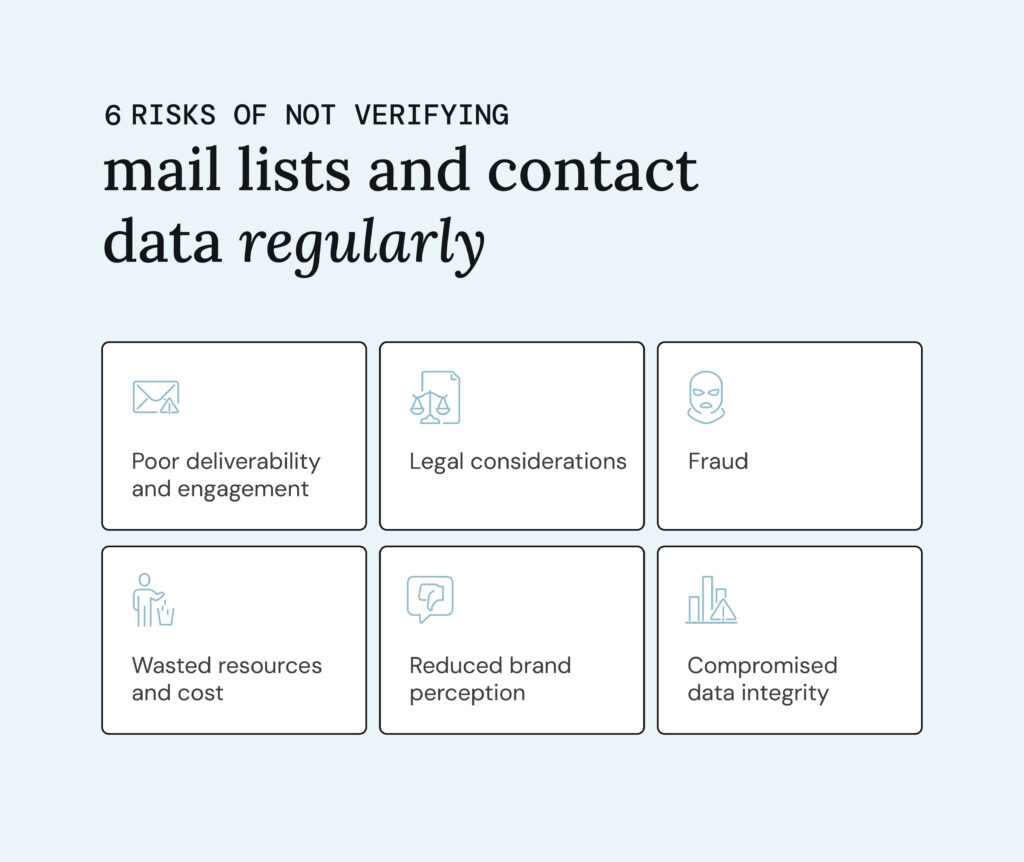
1. Poor deliverability and engagement
It’s frustrating to work hard on a well-crafted email campaign that doesn’t reach its intended audience. High bounce rates after sending to invalid email addresses signal to a mailbox provider (MBP) that you may be an untrustworthy sender. It’s like an instant red flag that can get your carefully constructed campaign sent straight to the spam folder.
Keeping your emails front and center in inboxes takes more than just watching bounce rates. When you’re tuned in to your sender reputation, you can spot sketchy addresses before they become trouble. That way, you dodge spam traps and make sure your messages land exactly where they belong.
With one in every seven legitimate emails already failing to reach inboxes, even for valid subscribers, failing to proactively validate lists just adds an additional layer of risk.
Even your good contacts start to suffer when your overall sender reputation declines—they’re less likely to see the emails they’ve opted in to receive.
Neglecting list verification can impact campaign deliverability and engagement in the following ways:
- Engagement metrics: Mailing to invalid email addresses will skew click rate data and other engagement metrics. This can make it impossible to accurately assess campaign performance and optimize future strategies.
- Blocklist risks: Sending messages to inactive addresses repurposed as spam traps can get your domain blocklisted. This can significantly reduce email deliverability and impact email-dependent marketing efforts.
- Time and resources: When sending to invalid contacts, you’re effectively paying to send emails that will never be seen. For high-volume senders, poor list hygiene can quietly drain thousands (or more) from marketing budgets.
Regardless of your industry, doing regular email list validation (which can improve email deliverability in the process) ensures your messages reach real, active contacts, who may actually do business with your brand.
2. Legal considerations
Keeping your email list clean and verified is crucial for legal compliance. Depending on where you do business, you’re likely dealing with regulations like GDPR, CCPA, and CAN-SPAM. They all have one thing in common: they expect you to know who you’re emailing, why you’re emailing them, and whether you should be emailing them at all.
Here’s a breakdown of each law:
- GDPR: If you’re marketing to anyone in the EU, GDPR applies—even if your business isn’t based there. It requires clear consent and responsible data handling. Holding on to outdated, unverified, or non-consensual email addresses can put you at risk of serious fines (up to 4% of global revenue).
- CAN-SPAM Act: This one’s all about transparency and control. People need an easy way to opt out of marketing messages they no longer want, and you can’t mislead them or force them into staying in your program. CAN-SPAM requires you to honor unsubscribe requests promptly. If your email list is full of bad or recycled addresses, you risk sending to addresses that shouldn’t receive emails anymore.
- CCPA: This law grants California consumers the right to know what data is collected about them and the right to request its deletion. Maintaining verified and accurate email data simplifies compliance with data subject access requests. If a customer requests data deletion, unverified data may not be deleted, leading to potential legal repercussions.
Email verification is the first line of defense in consent management. It protects your organization from legal penalties while establishing trust and transparency with consumers. Implementing small measures, like limiting access to a select few colleagues and regularly checking for duplicate data, can also reduce legal risks.
Marketing leaders need to prioritize email verification to help safeguard their brand from legal exposure and maintain ethical marketing practices.
3. Fraud
Fake email sign-ups, including bots filling out web forms with fake emails, are a major risk for all organizations. It can lead to wasted budget on fake leads and skewed performance metrics.
Bots can take advantage of free trials while taking up server space, increasing operational costs, and degrading the quality of service for real users. Inserting large volumes of fake email data can also overwhelm analytics and machine learning models, making it harder to identify security threats. Fake profiles can even be used to gather sensitive data from actual users or to spread malicious or false information.
A clean email database is much harder to penetrate. Having a robust email verification process at the point of sign-up prevents bot traffic from getting in and causing damage, ensuring marketing efforts target genuine prospects.
4. Wasted resources and cost
Neglecting emails and their verifiability can directly impact the cost and effectiveness of your marketing budget. Most ESPs use pricing models based on the number of contacts or volume of emails sent. When you consider a scenario where a campaign could involve sending a message out to 5,000 invalid emails, ignoring verification can mean paying substantially to send out mass emails that no one will read.
ROI impact may be one of the most noticeable risks of failing to regularly verify email lists. A clean email list ensures that every last penny of your marketing spend goes to a real person, naturally increasing your ROI potential.
It also offers the following resource and cost benefits:
- Increased conversion rates from a consumer base that’s actively engaging with your marketing
- Increased inbox placement rates, as emails are more likely to reach a target’s inbox
- Increased click-through rates from people who have likely subscribed and want to read your emails
- Increased accuracy of analytics to better understand campaign performance and future strategic choices
Email verification can also reduce the internal costs and resources used to track down invalid email addresses. Streamlining this process with verified emails can improve performance and morale across email-focused teams.
5. Reduced brand perception
Organizations can channel months of careful planning and consideration into an email campaign. The unfortunate truth is that poor email verification practices can undo all of this in seconds. Constantly landing in your target customers’ spam folders can damage brand perception, potentially reducing brand equity and customer loyalty.
Spam folders are associated with scams, junk, and low-quality content. If your emails keep ending up there, that perception can stick—even if your content is great. And once mailbox providers start associating your domain with spam-like behavior, it gets harder for marketing teams to recover their reputation and deliverability.
6. Compromised data integrity
At the end of the day, your email marketing strategy is only as good as your data. If your contact data is unreliable:
- Email automations break
- Email customer journeys stall
- Forecasting and planning for email campaigns get shaky
It’s a domino effect. All it takes is one bad email at the start of a workflow to throw everything off. Multiply that across thousands (or millions) of email contacts, and you’re making decisions based on a distorted picture of your audience and marketing campaign performance.
Email verification keeps your foundation solid—so everything built on top of it actually works. Many businesses embrace innovative modern tools to maintain email list hygiene and prevent these issues from impacting their long-term marketing plans.
How to verify email data quality
There’s no one “perfect” approach to email list verification—but the best teams usually layer a few simple strategies together, including:
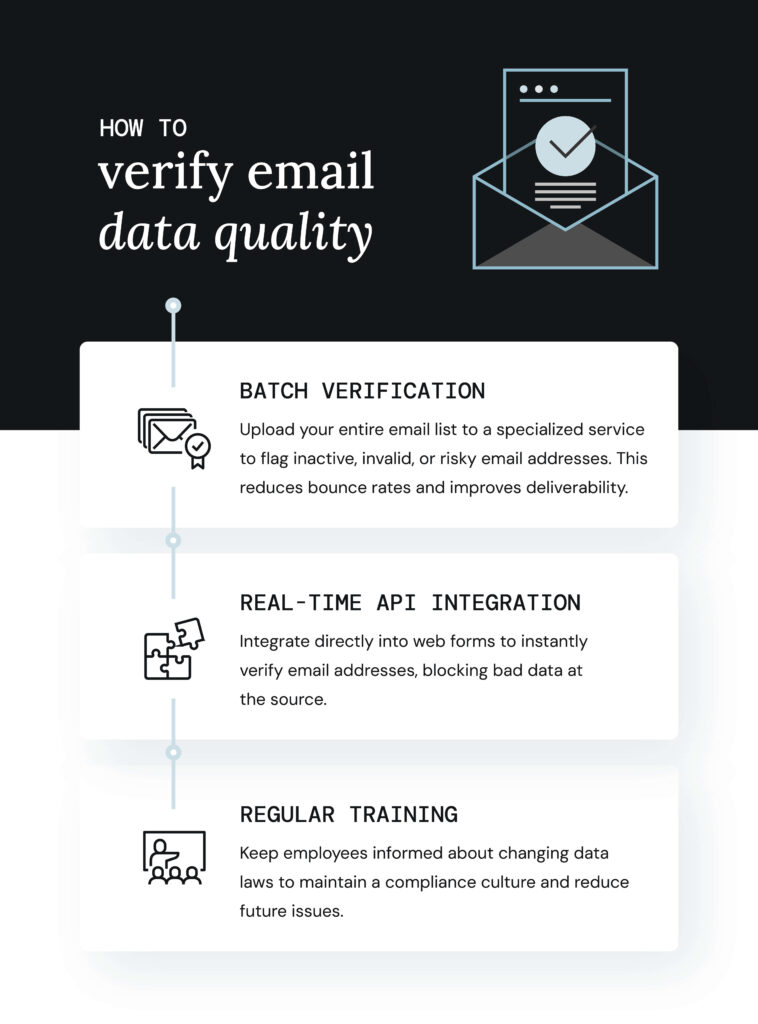
- Batch verification: This method is often used in aged email databases. It involves uploading your entire email list to a specialized verification service. The list is processed thoroughly, flagging any inactive, invalid, or potentially risky email addresses. Some organizations use this method for quarterly data hygiene checks or after large data migrations, but Validity recommends validating your email list before every send. Optimizing data this way can help reduce bounce rates and improve email deliverability.
- Real-time application programming interface (API) integration: This method prevents dirty email data from entering systems in the first place. Real-time API verification integrates directly into your web forms and sign-up pages. The system can immediately prompt the user to correct incorrect data, instantly blocking bad data at the source. It’s suited for tech and SaaS companies with high-volume sign-ups, ensuring new leads are captured with a verifiable contact point.
- Regular training: This method involves keeping key decision-makers and employees who handle customer information informed. As laws may continue to change and expand across the country, having a compliance culture in place reduces issues later on.
By leveraging automated email verification services, organizations can implement both batch and real-time strategies. This establishes a strong defense against the spread of false email data and contributes to a more reliable communication ecosystem.
Regularly verifying email data to improve business operations
The combined risks of poor email list validation can quickly turn into advantages with the right approach. Verified email lists can provide the framework for stronger branding, fewer technical failures, and less wasted budget.
Think of assessing your email databases as an opportunity to reach a stronger customer base. With fewer dead ends and a fresh perspective, your organization can build a more efficient, robust email marketing plan that relies on concrete data. In time, your email marketing plans can become something consumers look forward to receiving, trusting you with their time, money, and sensitive information.