The headline
Gmail has traditionally delivered the highest average inbox placement rates (IPRs) of any mailbox provider (MBP). This year, that’s changed dramatically—deliverability at the world’s biggest MBP has plummeted.
With Black Friday just around the corner, let’s look at what this means for email senders and marketing leaders.
What’s happening?
Validity’s latest deliverability benchmark report (covering 2025) put Gmail’s performance at the top of the leaderboard with an 89.8 percent inbox IPR, followed by Yahoo at 87.3 percent and Microsoft at 77.4 percent. That performance continued into Q1 ‘26, with Gmail IPRs averaging 90.97 percent. But by Q3 ‘26 they dropped to 81.57 percent—a 9.4 percent reduction.
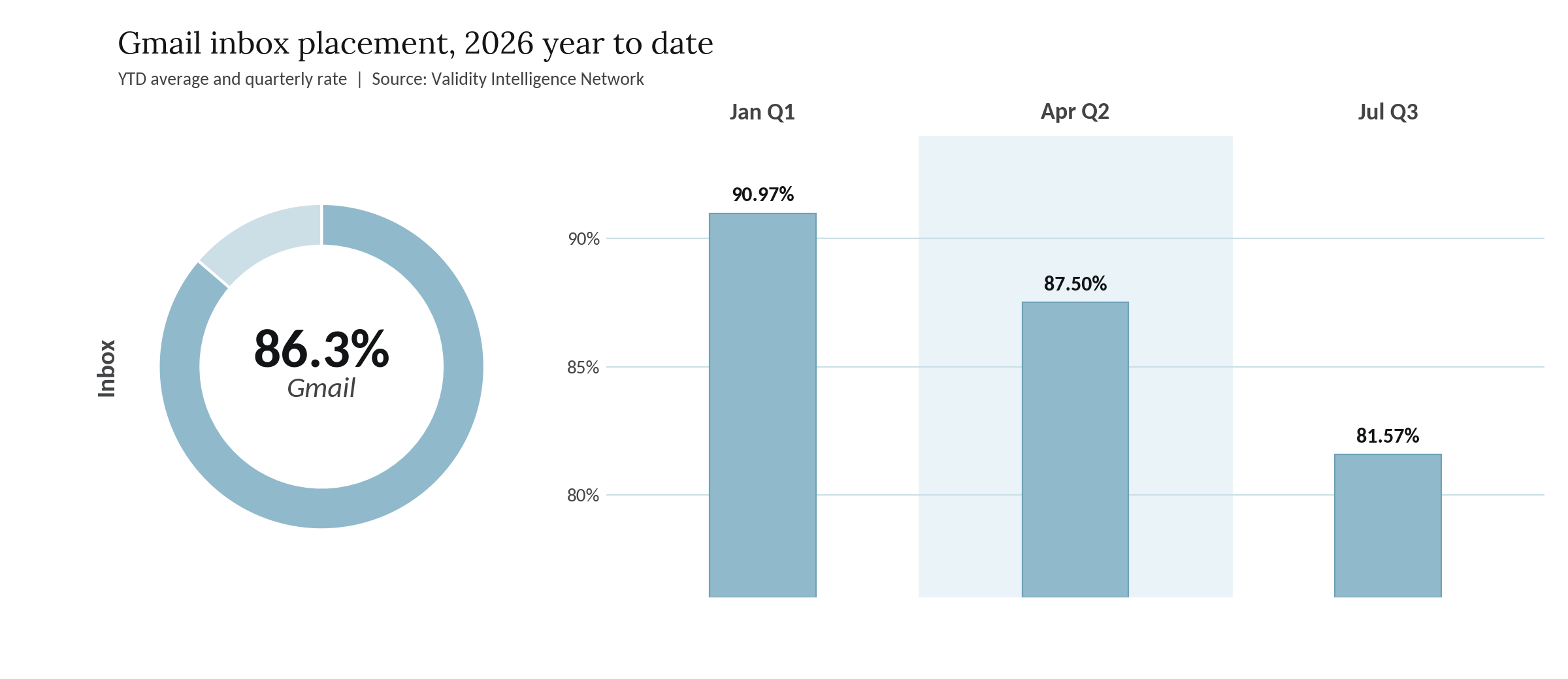
Two underlying metrics are driving the drop. Over 2026, Gmail spam placement rates have risen by three quarters (from 5.4 percent to 9.5 percent), while missing rates (blocked and rejected) are up 2.5 points (from 3.6 percent to 8.9 percent).
The news is even worse for B2B senders. Average IPRs at Google Workspace have dropped like a stone from 88.9 percent to 74.3 percent—a 14.6 percent delta. That’s before the additional impact of corporate spam filters like Proofpoint.
What marketers should know
So why is this happening? We believe it’s a perfect storm of factors:
- Bulk sender requirements introduced in 2024 are now fully enforced. Non-compliance with authentication, one-click unsubscribe, and low complaint-rate stipulations means more spam and rejections.
- New Gmail functionality like the relevance-sorted Promotions tab and automated Annotations means reduced engagement for senders whose content is no longer getting seen.
- We’re also starting to see the combined impact of AI-generated summaries and AI assistants in the inbox, which further reduce human engagement with senders’ messages.
Measurement drives management. It’s more important than ever for marketers to closely monitor their sender reputation, inbox placement, and maintain consistent compliance with MBP bulk sender requirements.
What marketing leadership should know
Globally, Gmail’s inbox market share is 40.4 percent, and in the US it’s 53.9 percent.
In broad terms, it forms half of most senders’ email programs—and now it’s roughly 10 percent less effective! If your email marketing generates an average of 11 cents of revenue per message, every million Gmail messages you send this Black Friday will generate $5,500 less than last year.
The key takeaway: in Gmail’s current world, less is more and quality trumps quantity. Getting your Gmail messages in front of a smaller, highly engaged cohort that converts to purchase is a far better outcome than zero visibility to a larger audience.
Don’t push your email teams to ramp up sending frequency and volume. Instead, encourage smaller sends that are highly targeted and relevant, drive engagement, and are discoverable to AI—and support investment requests aligned with these outcomes.